A verified Planet Zoo 2 animal trading prices table is not available in this prerelease guide, updated on 12 October 2026. The game launches on 13 October. You can prepare a sensible purchasing plan now, but exact asking prices, currency rules and market behaviour need to be checked in the released game. Treat the amount shown for an actual animal as an offer to evaluate, rather than a universal species price.
Animal adoption uses your zoo's cash, and the Planet Hub brings trading, storage and research together across locations within your current game mode. That makes a purchase part of a larger operating decision: you need an appropriate home, staff support and enough money to keep caring for the animal after acquiring it.
The useful question is therefore how much the animal will commit your zoo to spending. This page gives you a practical comparison method without assigning fictional prices to species or promising profitable trading routes.
Separate the asking price from the cost of ownership
An animal's acquisition cost is only the first part of your decision. A purchase that fits inside your current cash balance can still be unsuitable if the habitat needs substantial construction or the zoo cannot support its new resident consistently.
Compare three different commitments. First comes the purchase itself. Next comes the work needed before the animal can be housed properly. Finally comes ongoing operation, including the staff and infrastructure supporting the habitat. Keep these commitments separate so a low offer does not hide an expensive project.
Use the following worksheet as a planning structure. It is not a set of confirmed price categories in the trading interface.
| Decision | Information to check | Reason to delay the purchase |
|---|---|---|
| Acquire the animal | Actual offer and your available funds | The purchase consumes the money reserved for essential work |
| Provide its home | Space, terrain, plants, food, water and enrichment | The habitat is incomplete or unsuitable |
| Provide ongoing care | Keeper support, staff facilities and necessary utilities | The existing support network is already stretched |
| Use it in your network | Destination zoo and intended purpose | You have no clear place or role for it |
| Consider a later release | Research and species-specific release requirements | You are assuming eligibility that has not been established |
A financially sensible purchase should survive all these checks. Saving money on the acquisition does not compensate for failing to meet welfare needs.
Make the habitat part of the purchasing decision
Planet Zoo 2 animals have individual welfare requirements. Food and water, sufficient space, suitable terrain and plants, and social and enrichment conditions all belong in your buying decision. Do not choose an animal first and assume a spare enclosure can be adapted cheaply afterward.
Start by describing what your existing habitat can provide. Is it the right type of environment? Does its surrounding layout leave room for staff access and future adjustments? Is there a practical place to improve shelter and viewing without rebuilding the whole area? These are planning questions, not promises that a particular design will satisfy every species.
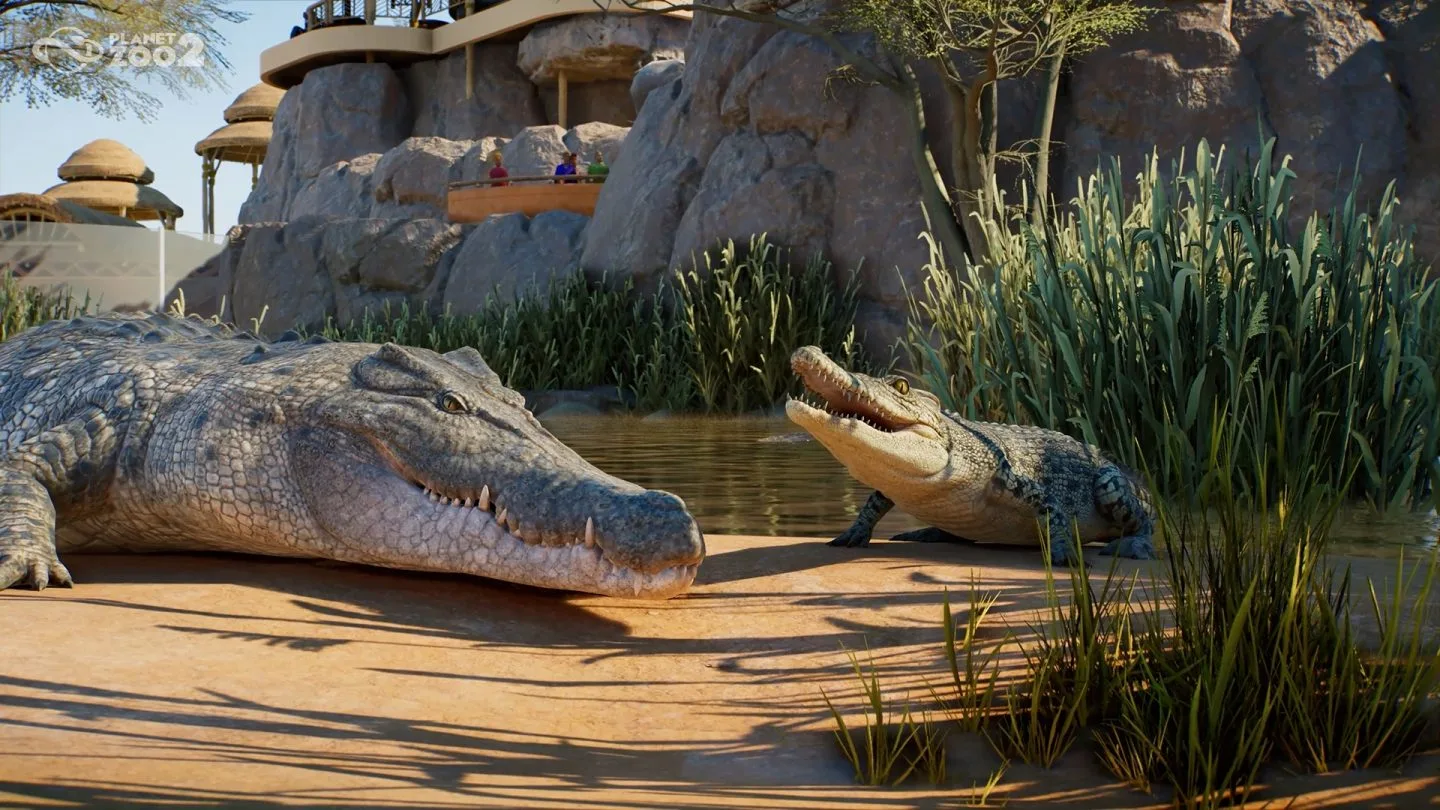
The crocodile habitat illustrates the physical side of ownership: the animal and its environment take up real space within the zoo. Use a view like this to think about land, water, shelter and the surrounding service area. It cannot tell you the animal's market value, and appearance alone cannot prove that every welfare requirement has been met.
If the habitat exists only as a decorative shell, count its unfinished work before judging the offer. A complete-looking building and a functioning animal home are different milestones.
Compare animals for the same immediate purpose
Comparisons work best when you hold the intended outcome steady. If you want an animal for a particular habitat, compare candidates that your current plan could actually support. If you want to expand the zoo's variety, identify which kind of addition the existing layout can accommodate. If your priority is conservation, check the relevant research and release requirements before buying for that purpose.
Do not compare an animal you can care for immediately with an animal that would require a whole new section as though the asking price were the only difference. The second offer includes a construction decision even if its displayed acquisition price is lower.
A useful note for each candidate contains the exact species, the offered individual or group, the displayed amount, the intended location and any missing preparation. Add only attributes that are actually shown or otherwise verified in your current game. Leave unknown fields blank rather than estimating them from the original Planet Zoo.
This creates a small, practical shortlist. It is more useful than a long price list filled with figures from a different game or mode.
Set a spending limit from the work still ahead
There is no evidence-based universal maximum price for every zoo. Your limit should come from your current operating position and the work the purchase creates. A large established network and a newly opened zoo can reasonably make different decisions about the same offer.
Before purchasing, identify money already needed for unfinished essentials. Staff salaries and energy bills are confirmed running costs, while expansion and hiring also require cash. Keep those obligations visible when deciding whether an offer is affordable.
A simple planning calculation is to take your current available funds and subtract money you have deliberately reserved for essential construction and operation. The remainder is a personal purchasing ceiling for that decision, not an in-game formula or a recommendation to spend every remaining unit of currency.
If you cannot estimate the unfinished work yet, the safer planning choice is to complete or scope the habitat first. This resolves a real uncertainty. Repeatedly checking offers does not tell you whether the zoo can support the animal once it arrives.
Use the Planet Hub to keep destinations clear
The Planet Hub supports trading, storage and research across locations within your current game mode. It also lets you view and visit zoos and Wildlife Reserves without returning to the main menu. Its role in your purchasing routine is to keep the wider network in view.
Decide which zoo the animal is intended for before committing money. A network can contain several attractive projects, but a purchase still needs a concrete destination and a reason to happen now. Avoid buying simply because another location might eventually use the animal.
Keep mode boundaries clear. The confirmed Hub scope is your current game mode; this guide does not assume that animals, cash or progress move freely between Career, Sandbox and Franchise. Verify the actual rules where you are playing.
After expanding to another location, revisit your purchasing priorities. Research and construction commitments can change which acquisition makes sense next. The Hub helps you see those commitments together, but it does not remove the need to check the animal's home and care locally.
Do not equate a displayed offer with a species benchmark
An offer is a single decision point. Without verified release-game information, this guide cannot establish how offers are generated, whether prices change with particular attributes, or how frequently a market refreshes. It also cannot identify a reliable average, cheapest time or profitable resale margin.
You can still keep an observation log once you have access to the game. Record what you actually see, including the species, displayed price, mode and relevant visible details. Record the moment of observation if comparing offers over time. This is a method for collecting your own evidence, not a claim about dynamic pricing.
Compare like with like. If two observations come from different modes or represent different kinds of offers, mark that difference before calculating an average. A neat-looking number can be misleading when its inputs describe different situations.
Until enough comparable observations exist, use terms such as current offer or observed price. Calling a number the normal price implies evidence this prerelease guide does not possess.
Avoid purchases justified by unverified future income
A new animal can contribute to your zoo's appeal and educational opportunities, but it should not be treated as a guaranteed return on investment. Exact visitor responses, donation amounts and payback periods are not established here.
Thriving animals are confirmed to live longer and encourage guests to donate more. Achieving that state requires research and a genuinely suitable environment. Buying an animal does not instantly provide those benefits, and the extra research and care should remain part of the plan.
Likewise, marketing campaigns can bring in more guests but also cost money. Do not budget a purchase around a campaign unless you have considered the spending involved. A loan provides immediate cash with an interest cost; it changes financing, rather than proving the acquisition is worthwhile.
Choose a purchase because it fits a viable zoo plan. Treat potential income improvements as outcomes to observe after the relevant conditions are met.
Build a repeatable offer review
Use this sequence when the released game presents an offer you are considering:
- Confirm the game mode and the location you are managing.
- Identify the animal and the actual terms displayed for the offer.
- Choose its destination and the specific purpose of acquiring it.
- Check the animal's applicable needs against the habitat plan.
- Review the staff and infrastructure required for ongoing care.
- Reserve funds for unfinished essentials and continuing operation.
- Compare suitable alternatives for the same immediate purpose.
- Commit only when the purchase fits both your care plan and your finances.
This sequence deliberately does not name unverified buttons or menu labels. Its purpose is to make the decision clearer, regardless of how the final interface presents the offer.
If a check fails, note the specific reason. Missing habitat preparation, insufficient operating room and an unclear destination require different fixes. Waiting without identifying the blocker makes it harder to know when the purchase becomes sensible.
Recognise a purchase you should postpone
Postpone an offer when you cannot explain where the animal will live, which needs are already met and what work remains. Also postpone it when your existing animals need attention that the new acquisition would compete with.
An attractive species can remain on your future plan without becoming today's purchase. Keeping the idea separate from the commitment lets you prepare properly and compare later offers with a clearer budget.
Before revisiting the purchase, finish the missing prerequisite you identified. That might be a habitat blockout, a nearby care facility, a staff allocation review or a research decision. The exact fix depends on your zoo rather than a universal price threshold.