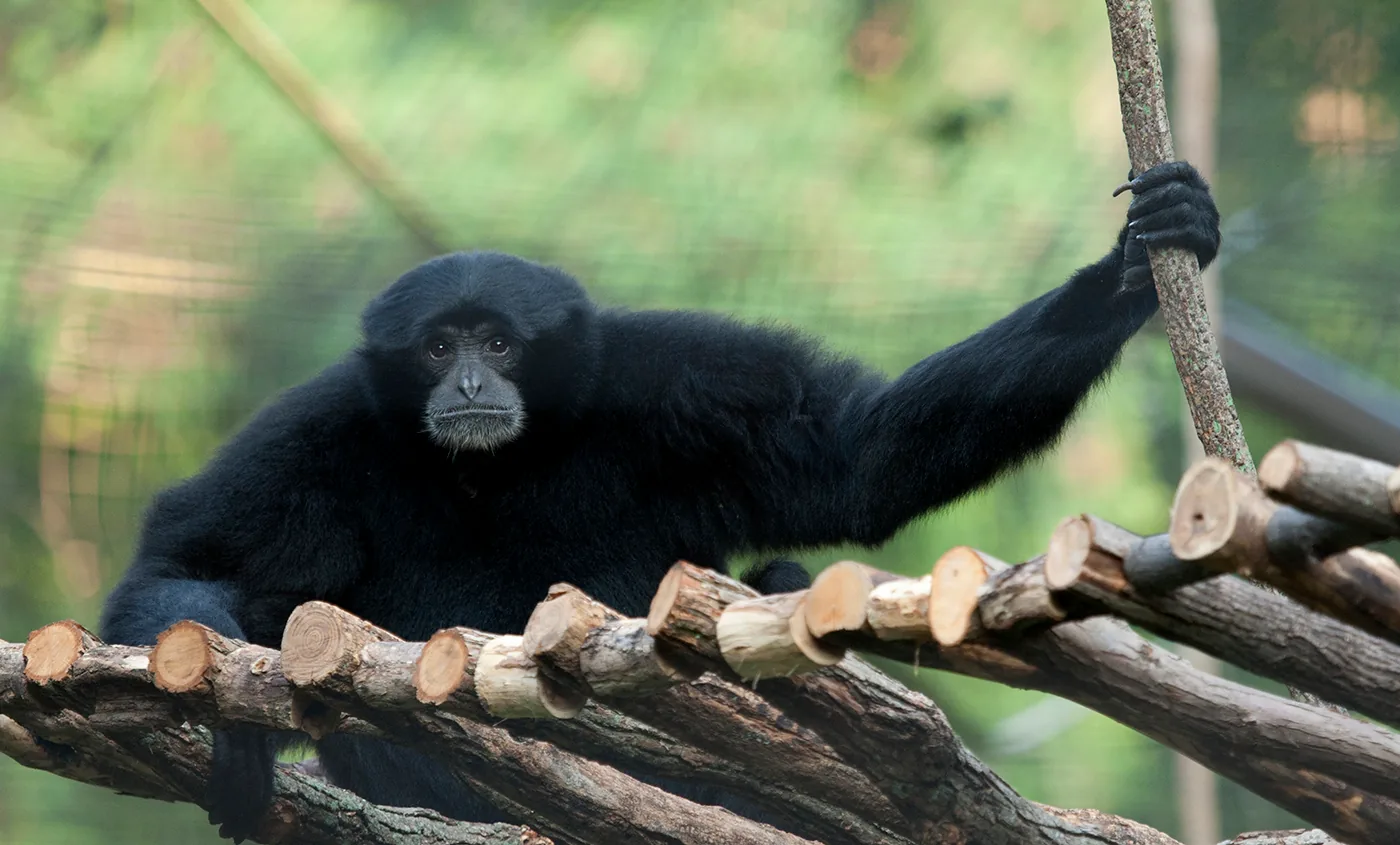
The siamang is confirmed for Planet Zoo 2. A climbing-focused forest exhibit is an appropriate creative direction for this arboreal ape, but its exact simulated area, climbing quantity, temperature range, social composition and compatible species are not verified here. Read the game's species values before adopting animals or fixing the final enclosure dimensions.
This October 12, 2026 guide covers pre-release planning and identification. It uses real siamang biology to explain what makes the species recognizable, then applies confirmed Planet Zoo 2 building and animal systems without presenting an untested habitat recipe. The suggested construction sequence is a way to organize decisions, not evidence that a particular branch arrangement guarantees good welfare.
Identify the animal before you build
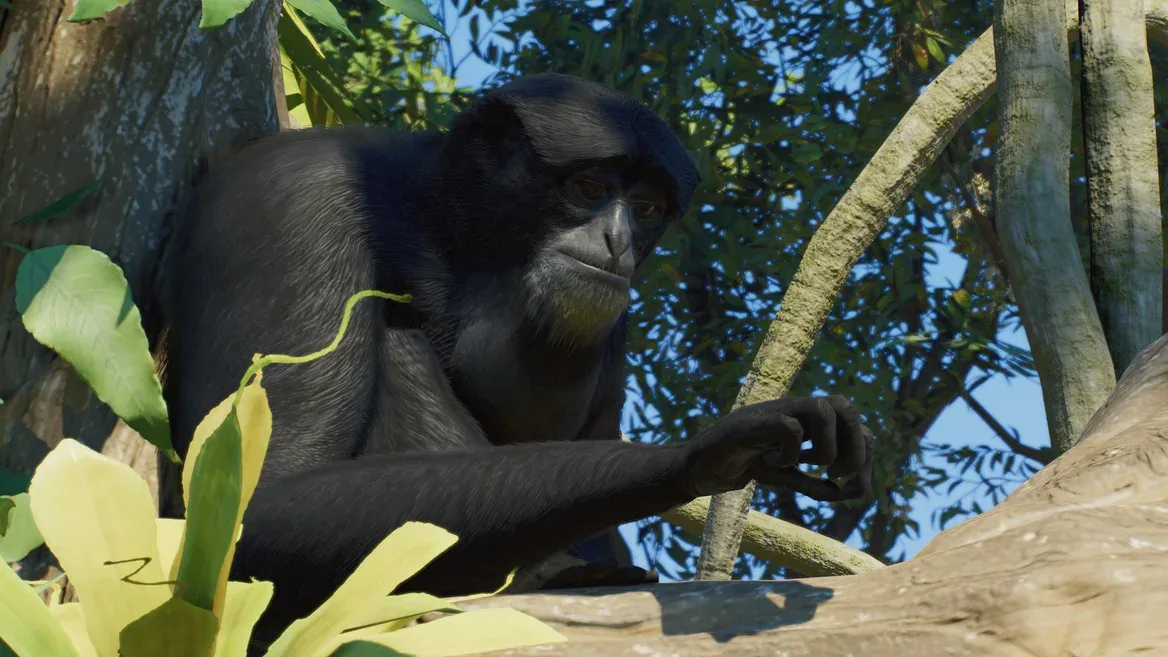
The siamang's scientific name is Symphalangus syndactylus. It is a gibbon and belongs to the lesser apes. Calling it a monkey obscures a useful identifying feature: siamangs have no tail. Look for black fur, long arms and a throat sac that can become conspicuous during vocalization.
The real animal uses hand-over-hand swinging through trees, known as brachiation. Its long arms suit that movement, while its body can also move upright on the ground. These facts help you recognize the species in a screenshot or educational display. They do not specify the game's clearance rules, minimum support spacing or a list of usable climbing pieces.
The throat sac is another important feature. It amplifies calls and makes the siamang distinctive among gibbons. A visible sac or an animated call can identify the animal, but one vocalization should not be treated as a numerical welfare reading or a guaranteed signal of a specific problem.
Start with a canopy-focused concept
Real siamangs inhabit forests in Sumatra and the Malay Peninsula and spend much of their lives above ground. A connected canopy is therefore a sensible visual concept. Plan an exhibit where the climbing structure can be understood from the guest side instead of hiding all movement behind a dense wall of trees.
As a creative recommendation, organize the first build around a few clear horizontal and vertical connections. This gives you a route to inspect before adding a large amount of decoration. The game must determine which pieces and positions are actually accessible, so the idea is deliberately simpler than a finished forest scene.
A tropical appearance does not prove the habitat's environmental settings are correct. Nor does a photograph of a wild forest provide a simulated plant coverage percentage. Use natural history to choose the scene's character; use the Planet Zoo 2 entry to determine care values and supported objects.
Plan movement before background scenery
The siamang's recognizable movement makes the arrangement of the climbing area central to the display. Think about a connected path through the proposed structure rather than a collection of attractive but isolated platforms. A useful first sketch identifies how an animal could move between the main parts of the exhibit.
That sketch is not proof of traversability. Planet Zoo 2 supports interactions with accessible objects, and the actual game must resolve whether a specific placement is usable. Keep the arrangement readable so that you can investigate a missing connection without dismantling an entire themed building.
Avoid designing the guest view entirely around one hoped-for jump or swing. The official systems support more varied behavior, but no exact siamang animation sequence is promised here. A successful creative plan should still look coherent if the animal rests in a different place or uses the route in a different order from the one you imagined.
Leave dimensions open until the species values are known
This guide does not contain a verified minimum habitat area or climbing allowance. Any number taken from the first Planet Zoo, a real zoo enclosure or another primate would be a guess for the sequel. Preserve that distinction even if a familiar-looking animal makes an old care sheet tempting to reuse.
Choose a site where the climbing arrangement can be expanded or reorganized. Keep permanent guest buildings away from every edge during the first pass. This is a practical construction recommendation: it leaves you options if the actual species values require a different layout. It does not claim that spare land gives a direct welfare bonus.
Separate the enclosure footprint from its service surroundings. A large area visible on your zoo plan may include guest paths, scenery and buildings outside the animal's home. Do not describe the total themed district as the siamang's usable habitat. Keep each part of the plan identifiable before you calculate or compare anything.
Use social biology as context, not a numeric rule
Real siamangs commonly live in family groups formed around an adult pair and offspring. They coordinate activities, groom and use calls in their social lives. That description gives the species a coherent educational story, but it does not establish Planet Zoo 2's minimum or maximum group size.
Before choosing animals, read the simulated group composition and any other relevant entry information. Do not assume that a real family arrangement supplies the correct number of males, females or juveniles in the game. Keep breeding decisions separate until you have the necessary species and mode information.
A photograph of several siamangs together also does not establish compatibility with another primate. Geographic overlap, a similar diet and a shared forest theme cannot certify a mixed exhibit. If the game's compatibility information remains unresolved, plan a siamang-focused enclosure and leave potential additions for a later verified decision.
Treat calls as observation rather than diagnosis
Siamangs are known for loud calls and coordinated vocal displays. The throat sac can produce a low booming sound, and the animals also produce other calls. These are real biological characteristics; they explain why sound is a valuable part of recognizing and learning about the species.
Planet Zoo 2's animal audio is more closely connected to movement, behavior and mood than before. That broad system confirmation does not create a simple code in which every siamang sound maps to a named welfare issue. Do not claim that silence proves illness, or that a particular call guarantees the animal is thriving.
When observing your enclosure, compare what you hear with the animal's reported condition and the setup you can inspect. A sound can prompt a closer look without becoming a conclusion. Keep your notes specific to the animal and situation rather than turning one observation into an unsupported rule for all siamangs.
Separate natural feeding from game food objects
Real siamangs eat fruit and leaves, with other foods forming a smaller part of their diet. They can feed while suspended from one arm. Those details are useful for understanding how their forest lives differ from a ground-feeding animal's routine.
They do not establish the game's food item, feeding facility, food quality level or food bill. Select the feeding setup using the actual species information. A leafy scene and a decorative fruit display can support the exhibit's story, but neither should be described as functional food unless the game supports that use.
As a planning method, place the required feeding elements where you can evaluate access before surrounding them with dense decoration. If you later integrate them into a climbing scene, recheck the animal's ability to use them. The value of this sequence is clarity: you can distinguish a functional choice from an aesthetic one while the habitat is still easy to change.
Build viewing angles that show the animal
A canopy animal can be difficult to see from a low path when leaves and structural supports overlap. Think about the side view early. Choose an angle that can show the siamang's long arms and climbing position, then use the background to reinforce the forest setting.
An elevated viewing route is a possible creative idea, but it is not a verified species requirement or a guaranteed improvement to guest satisfaction. Evaluate it using the actual building tools and the available site. A simpler side view may be easier to build and maintain while you learn the enclosure's functional layout.
Do not create a route that depends on every animal gathering at the same place. Planet Zoo 2's revised behavior system encourages variety. Give your display several readable observation points instead of treating one screenshot position as the only acceptable place for the siamang to spend time.
Keep resting behavior in perspective
Real siamangs are diurnal, with activity during daylight and resting periods as part of a daily routine. That natural pattern does not provide a verified Planet Zoo 2 schedule. A single resting observation is insufficient to diagnose a construction problem or predict how much time the species will spend in a particular location.
The sequel's animal decisions can take account of time, weather, season and internal state. Use that confirmed context to avoid treating every change in behavior as a fault. Then inspect the animal's actual needs and accessible environment when you have a specific concern.
As a design recommendation, include visually quieter parts of the scene without hiding every possible resting position from view. This lets the exhibit remain interesting during lower activity. It does not certify a shelter requirement, a shade percentage or a specific sleep object; those decisions still require the game's actual species information.
Give the conservation theme a clear purpose
The real siamang is endangered, and forest loss and the illegal pet trade are major threats. A conservation-focused exhibit can therefore explain why protecting connected forest habitats matters. Keep the educational message specific to the species rather than adding a generic claim that every tree you place restores wild populations.
Planet Zoo 2 includes Wildlife Reserves and conservation projects, but this guide does not establish a siamang-specific release checklist or reserve reward. A real animal's conservation story is valuable context and cannot replace the game's release requirements.
If you intend to include the species in a wider conservation plan, first complete the zoo habitat and learn the relevant in-game conditions. Avoid promising that the same enclosure or family arrangement will automatically satisfy a reserve project. The two ideas can share a theme while requiring separate management decisions.
Complete the first siamang habitat methodically
Confirm the species and read its actual requirements. Reserve the enclosure and service connection, then build a simple climbing arrangement with several clear inspection angles. Add the supported feeding and enrichment elements before completing the forest decoration.
After introducing the animal, use its reported needs and observed access to evaluate the arrangement. Recheck your guest views at several possible animal positions. Add structural complexity only when the enclosure remains understandable and you can still identify which parts provide function.